By Fatiah Adejobi
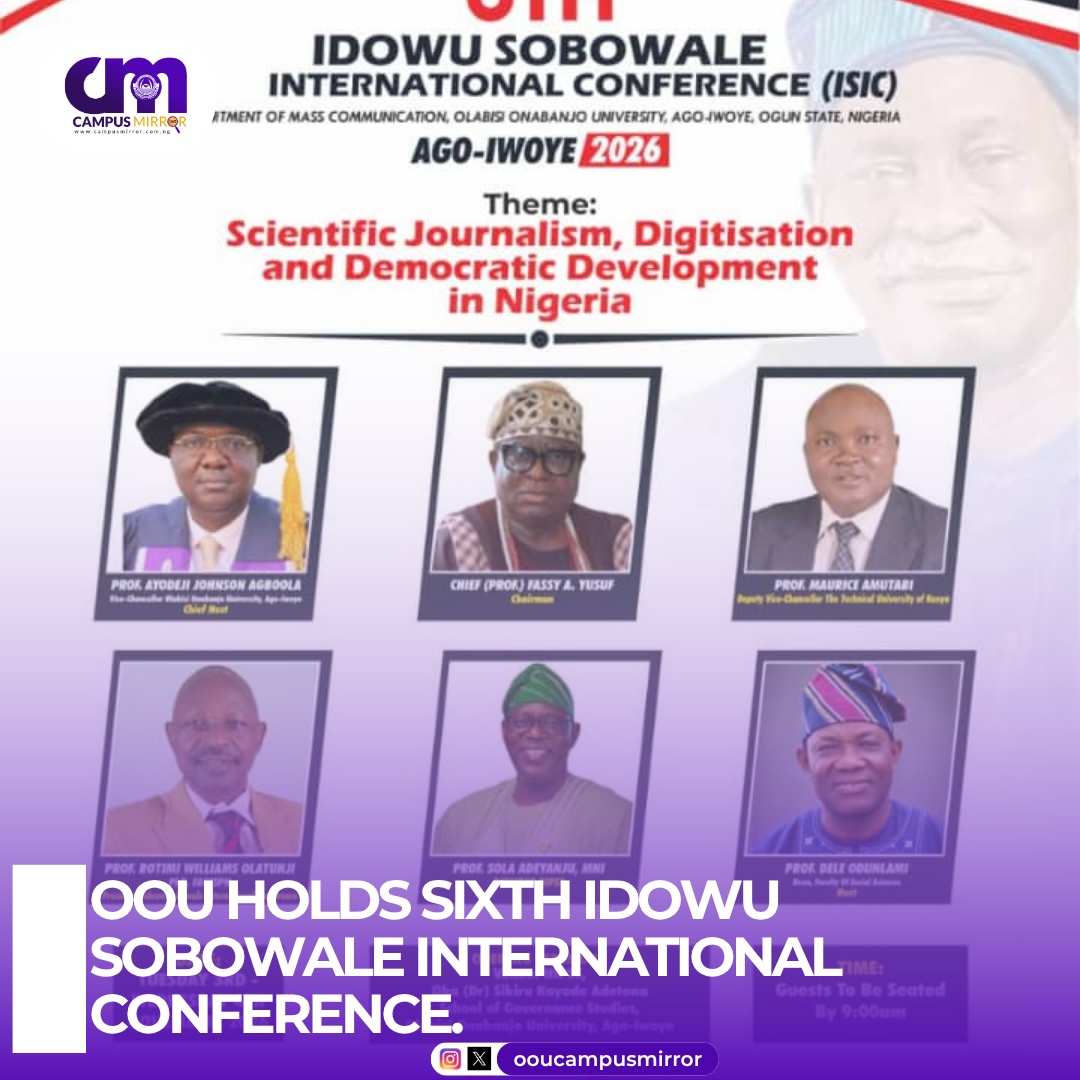
The Department of Mass Communication, Olabisi Onabanjo University (OOU), in collaboration with the Idowu Sobowale Foundation, has held the Sixth Idowu Sobowale International Conference, bringing together communication scholars, media professionals, academics and other stakeholders to examine the relationship between scientific journalism, digitisation and democratic development in Nigeria.
The two-day conference, held on Tuesday, November 3, and Wednesday, November 4, 2026, at the Oba Sikiru Adetona School of Governance Hall, OOU, Ago-Iwoye, was themed “Scientific Journalism, Digitisation and Democratic Development in Nigeria.”
The conference provided an academic platform for discussions on the changing nature of journalism, the growing influence of digital technology on information dissemination and the responsibility of the media in strengthening democratic institutions.
At a time when digital platforms have significantly altered how information is produced, distributed and consumed, the theme highlighted the need to examine how journalism can maintain its credibility and relevance while adapting to technological advancements.
The growing dependence on digital platforms has created new opportunities for media organisations to reach wider audiences and facilitate public participation. However, it has also introduced challenges relating to misinformation, the circulation of unverified information and the increasing pressure on media practitioners to prioritise audience engagement over journalistic accuracy.
Against this backdrop, the emphasis on scientific journalism raises important questions about the place of evidence-based reporting, research and data in contemporary media practice. It also reinforces the need for journalists to adopt rigorous methods of information gathering, verification and interpretation, particularly when reporting issues that affect public policy and democratic governance.
The conference’s focus also reflects the broader significance of journalism in democratic societies, where access to credible information enables citizens to make informed decisions, participate in public discourse and hold institutions accountable.
Among the dignitaries present were the Vice-Chancellor of OOU, ably represented by Prof. Nike Fehintola Onifade, University Librarian; the keynote speaker, Prof. Maurice Amutabi, Deputy Vice-Chancellor, The Technical University of Kenya; the Chairman of the occasion, Chief (Prof.) Fassy Yusuf; President of the Idowu Sobowale International Conference, Prof. Rotimi Olatunji, MNIPR; Lead Presenter, Prof. Sola Adeyanju, MNI, MNIPR, Director, NIPSS-OSKASOGS; deans of faculties, heads of departments, lecturers from within and outside the university, media professionals and students, among others.
Delivering the keynote address titled “Digitisation, Knowledge Production and Democratic Resilience Across Africa,” Prof. Maurice Amutabi examined the transformation of journalism from traditional media platforms to the digital space and its implications for individuals, institutions and political engagement.
He highlighted the extent to which digital technology has reshaped human interactions and the dissemination of information, noting that the media’s influence now extends beyond conventional news reporting into various aspects of social and political life.
According to him, the increasing migration of media activities to digital platforms has significantly changed the dynamics of information consumption and audience engagement.
He, however, expressed concern about the growing tendency to measure the value of media content through online engagement metrics rather than the accuracy and credibility of the information being circulated.
“The future of the media in Africa lies in the digital space. Attention has now shifted from accuracy to number of likes, shares and comments. There is a need for sensitisation in order to achieve a better society,” he stated.
His remarks drew attention to one of the central challenges confronting contemporary journalism: the need to embrace technological advancement without compromising the professional standards and ethical responsibilities upon which credible journalism is built.
While digital platforms have democratised access to information and created opportunities for broader participation in public conversations, the ease with which information can be published and circulated also makes verification increasingly important.
For media practitioners, this places greater responsibility on journalists to distinguish credible information from misleading narratives, especially in an environment where false information can spread rapidly and influence public opinion.
Beyond the immediate impact of digitisation, the conference’s emphasis on scientific journalism highlights the importance of research-driven reporting in contemporary society.
Scientific or precision journalism encourages the application of research methods, statistical analysis and empirical evidence to news gathering and reporting. Its relevance is particularly evident in the coverage of elections, public opinion, governance, health, the environment and other issues requiring accurate interpretation of information.
In this regard, journalism becomes more than the documentation of events. It becomes a means of investigating societal problems, examining public policies and providing citizens with information that can support informed decision-making.
The intersection of scientific journalism and digital technology therefore presents both opportunities and responsibilities for the media. Although digital tools have made information more accessible, the ability to gather, interpret and communicate accurate information remains essential to maintaining public trust.
The Idowu Sobowale International Conference also carries significance as a platform established to sustain intellectual engagement with the contributions of Professor Idowu Sobowale to journalism, communication scholarship and public discourse.
Professor Sobowale was recognised for his contributions to precision journalism and the development of public opinion polling in Nigeria. His work helped establish a stronger relationship between journalistic practice and systematic research, particularly in the reporting and interpretation of public opinion.
The conference, first organised in 2009, has provided opportunities for communication scholars and media professionals to examine emerging developments in the media industry while engaging with issues relating to journalism, governance and national development.
The sixth edition’s focus on scientific journalism and digitisation continues this tradition by bringing contemporary questions about technology, knowledge production and democratic development into academic and professional discussions.
As journalism continues to evolve, the need to preserve accuracy, professional integrity and public accountability remains fundamental. The conversations surrounding the conference’s theme therefore extend beyond the media industry to the broader question of how societies can benefit from technological advancement while sustaining informed and responsible democratic participation.