By Oke Chloe Inioluwa
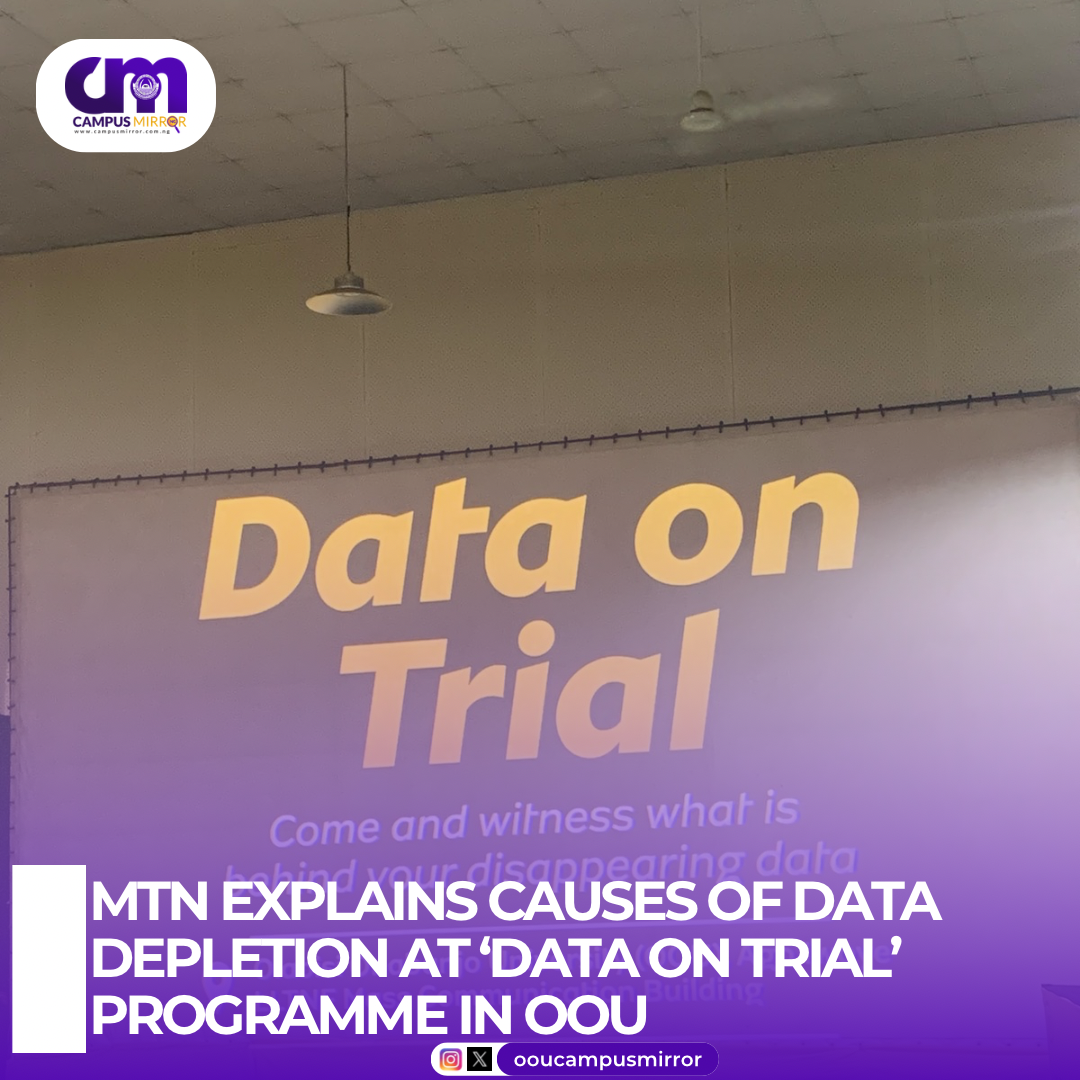
MTN Nigeria has explained some of the factors responsible for rapid data consumption among subscribers during an interactive programme tagged Data on Trial, held on Thursday, November 12, 2026, at the Mass Communication Building, LLTNF, Olabisi Onabanjo University (OOU), Ago-Iwoye.
The programme, organised as an open court session, gave students the opportunity to question the telecommunications company on complaints of rapid data depletion, network interruptions, data expiration and other challenges associated with its services.
The event was hosted by Timi Agbaje, who described data as a necessity rather than a luxury.
“Data is not just a luxury; it is a necessity,” he said, adding that the programme was designed to help participants understand how data works and the factors responsible for its consumption.
The session featured Faculty of Law students as prosecutors, MTN representatives as defence counsel and 400-level Computer Science students as witnesses.
The prosecution team was led by Henry Enitan, alongside Banjo Adeniyi, Adeoye Temilola and Alagbe David, while the defence team comprised Oluseye Olatunde, Oluwafemi Adeshina and Nathan Clifford.
Presenting the case on behalf of subscribers, Enitan questioned whether rapid data depletion was explainable and justifiable, the extent to which background applications contributed to data consumption and why subscribers lost unused data after the expiration of their bundles.
Other members of the prosecution raised concerns about background data usage, data expiration and MTN’s complaint resolution process. One of the prosecutors compared the expiration of unused data to buying a bag of rice only for the seller to collect what remained after a year.
The prosecution also questioned whether subscribers received satisfactory responses when they reported problems with the company’s services.
Three Computer Science students, Akintayo, Ngozi and Philip Peace, served as witnesses. They raised questions about network interruptions, data measurement, background applications, operating system updates and accidental subscriptions through pop-up notifications.
Other students also shared their experiences. Olayinka, a 100-level Economics student, questioned why subscribers should lose their data when network interruptions prevent them from using their bundles within the validity period. Silver, an Accounting student, also raised concerns about data rollover when network disruptions affect subscribers.
A 300-level student recounted subscribing to a 10GB data plan and expecting a 3GB download to leave 7GB in his bundle. However, he said he discovered that 7GB had been deducted after the download.
Sheriff Ayodeji, a 100-level Economics student, however, noted that some subscribers unknowingly consume data through downloads on social media platforms such as TikTok.
Following the prosecution and witness sessions, a presentation explained how internet data works, including the roles of Transport Layer Security (TLS), Domain Name System (DNS) and Internet Protocol (IP) addresses.
An MTN representative identified video quality, network generation and background applications as factors that influence data consumption. The representative explained that using 4G and 5G networks could contribute to higher data consumption, particularly when streaming high-resolution videos.
The representative also discussed how applications such as WhatsApp consume data through automatic media downloads, especially when users belong to several groups with automatic downloads enabled.
Another presentation was delivered by Mohammed, a senior AI researcher at Tecno, who explained how the pixel count and image quality of modern mobile phones could affect data consumption when pictures and other media files are uploaded or downloaded.
During the defence session, Nathan Clifford explained how MTN measures data consumption and charges subscribers, identifying three stages in the process: the device layer, the network layer and the charging layer.
He also highlighted the company’s use of reconciliation accuracy indicators, variance monitoring, audits and governance processes to monitor its billing system.
On network interruptions, the defence team attributed some service disruptions to damage to fibre-optic cables, particularly during road construction and other activities.
The team advised subscribers to monitor their data usage through their phone settings and the MyMTN app to identify applications consuming data in the background.
On data rollover, MTN representatives explained that eligible data plans could be rolled over within seven days after expiration, subject to the conditions attached to each plan.
The cost of accessing customer service also came up during the question-and-answer session. A participant questioned why subscribers were charged for calling MTN’s 300 customer service line. Two students were invited to call the line to verify the claim and reported that they were not charged.
The programme ended with a demonstration on data consumption monitoring. Participants were shown how to check their daily data usage by dialling *312*700# and how to opt out using *312*60#.
Subscribers were also encouraged to use the MyMTN app to check their usage history, monitor their data consumption and access the MTN data calculator.